Figure 17: Externalities and the technologies addressing them align with the Innovation Diffusion Curve with more enduring effects than traditional
Summary: Problem Solvers follow a relevance-driven diffusion curve. Their adoption is not driven by novelty or convenience, but by the growing urgency of the systemic challenges they address. As externalities intensify, so does adoption, accelerated by alignment with regulation, consumer demand, and participation from mainstream businesses. This process unfolds in three stages: limited early action, growing resistance and market readiness, and finally, widespread adoption as solving the problem becomes unignorable.
To capture enduring value, investors must back companies solving structural problems before capital, consensus, or policy catch up.
Clayton Christensen’s disruption theory helped explain early venture success. Christensen posits that the role of venture is to identify innovation early in the adoption cycle. By supporting companies and subsidizing innovation in the early stages it provides a route to outsized financial value when the company innovation does achieve mass-market adoption. The negative externality curve follows a similar path. By identifying negative externalities early, and investing in the solution, investors also have a path to finding outsized value. A negative externality provides a market that innovation must solve. The more profound the externality on people’s lives – the increased demand for a solution. By following a negative externality earlier in its journey and in the solutions adoption curve (before the solution is mainstream) it provides investors with a pathway to isolating value potential.
This is why the most enduring companies don’t just chase trends. They solve for systemic risk early, before it’s rewarded. These Problem Solvers create value not through marginal gains, but by building foundational solutions to persistent externalities that undermine resilience, trust, and long-term systems integrity. And because they do so before consensus forms, their relevance – and returns – compound as the world shifts around them. The adoption curve tends to unfold in three stages (as illustrated in Figure 17), each rooted in the scale and persistence of the problem they aim to solve – and the lasting value they unlock.
1. Persistence of a Negative Externality: A foundational challenge becomes increasingly visible. Yet incentives are weak. Entrepreneurs working in these spaces are often early, underfunded, or dismissed
2. Resistance Meets Momentum: The externality gains visibility. Consumers shift. Governments legislate. Founders and early investors begin gaining traction. Momentum builds – quietly at first, then exponentially.
3. The Tipping Point: Market structures shift. What was once niche becomes inevitable. Capital floods in. Incumbents are disrupted not just by better products, but by models that make them structurally obsolete.
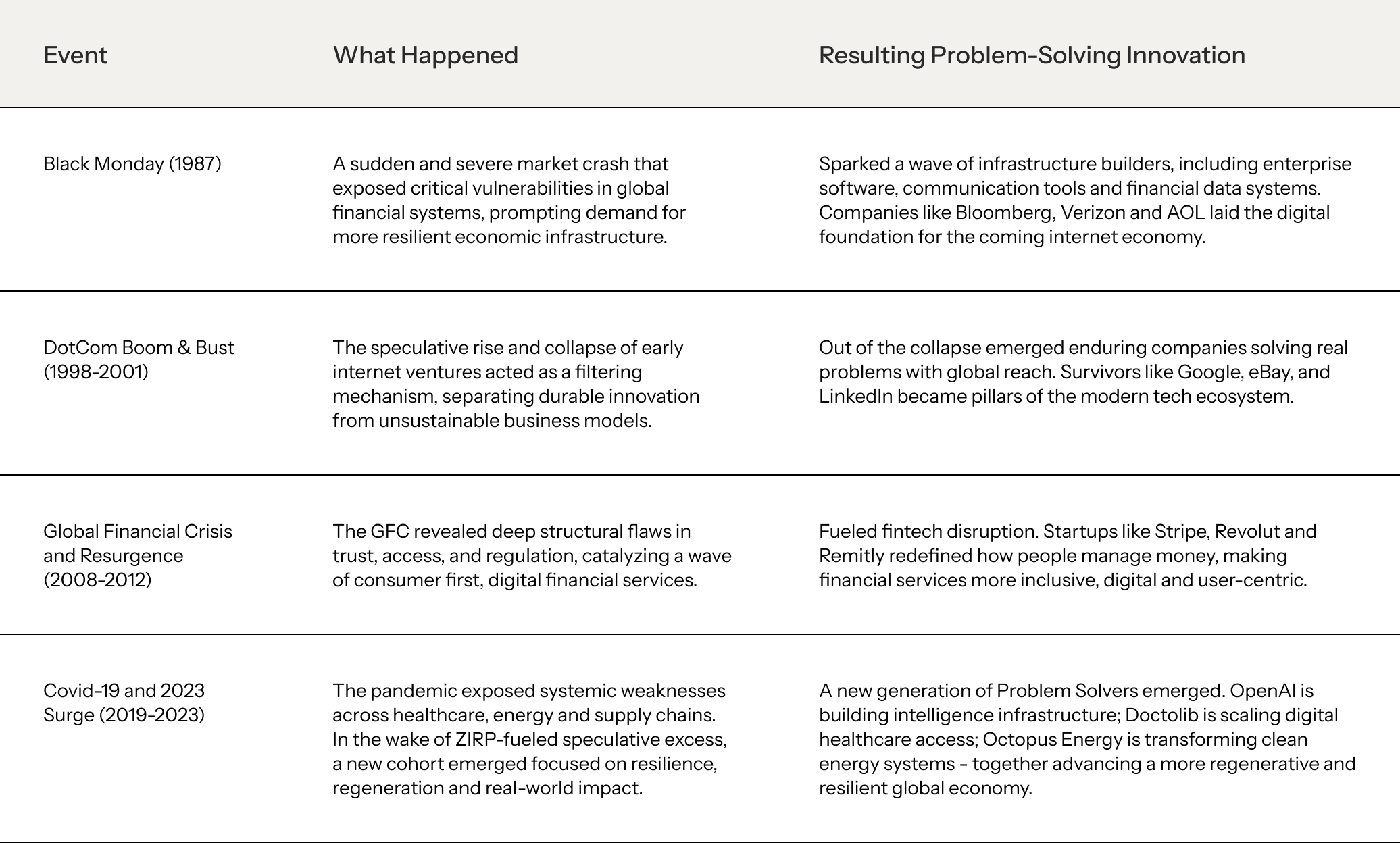
Many of the world’s most successful companies demonstrate the financial value of solving problems early. Companies that have placed early, high-friction bets that addressed systemic externalities long before consensus formed. To address healthcare vulnerabilities, Moderna invested early in mRNA platform technology – a capital-intensive, high-risk approach with little near-term payoff.
But when COVID-19 hit, that platform enabled one of the fastest vaccine rollouts in history. To address emission-intensive transport, Tesla built out the electric vehicle supply chain amid deep regulatory and market skepticism. To address financial exclusion, Stripe turned digital payments into infrastructure – making financial tools accessible to small businesses and creators globally, while traditional banks remained fragmented and slow to adapt in the wake of the Global Financial Crisis.
These firms faced resistance, regulatory pressure, and market doubt – but persisted, aligning their growth with long-run externalities: decarbonization, health resilience, and financial access. Their dominance reflects the Problem Solver arc: identifying persistent friction, gaining momentum through aligned consumer and policy shifts, and ultimately redefining market baselines. By solving continuously solving early for problems others ignore and adapting their models as technologies evolved, Problem Solvers ultimately become the infrastructure much of the economy now relies on.
Benevolent Disruption shows us where to look now: at the world’s most persistent externalities. Enduring value is created not by cheaper tech, but by building systems people can rely on – especially as externalities become central to both regulation and consumer behavior. The sooner a company starts solving, the more of the upside it captures.
Key takeaway for capital allocators:
For investors, the clearest path to resilience and long-term value lies in backing companies that solve early: turning pain points into essential infrastructure, and systemic risk into scalable, enduring returns.