benevolent disruption
from  
Watch the video
Thesis Community Capital
Skip to main content

“When I invented the web, its trajectory was impossible to imagine… It was to be a tool to empower humanity. Yet in the past decade, instead of embodying these values, the web has instead played a part in eroding them”

Tim Berners-LeeFounder of the Internet

"The truth is, the venture business (as a whole) has not risen to the occasion... As an industry, we think our only job is to spawn companies, ‘disrupt’ markets, deliver strong returns for our LPs and personal wealth for ourselves… and assume society will figure out the rest. This is not the way to build enduring companies or leave a meaningful legacy.”

Hermant TanejaCEO, General Catalyst

“Since the turn of the millennium, if a fund manager had invested on the thesis of targeting the subset of companies tackling humankind’s biggest problems, they would have generated 51% higher returns and increased their chances of striking an outlier by more than 27%”

David ClarkeChief Investment Officer, VenCap International

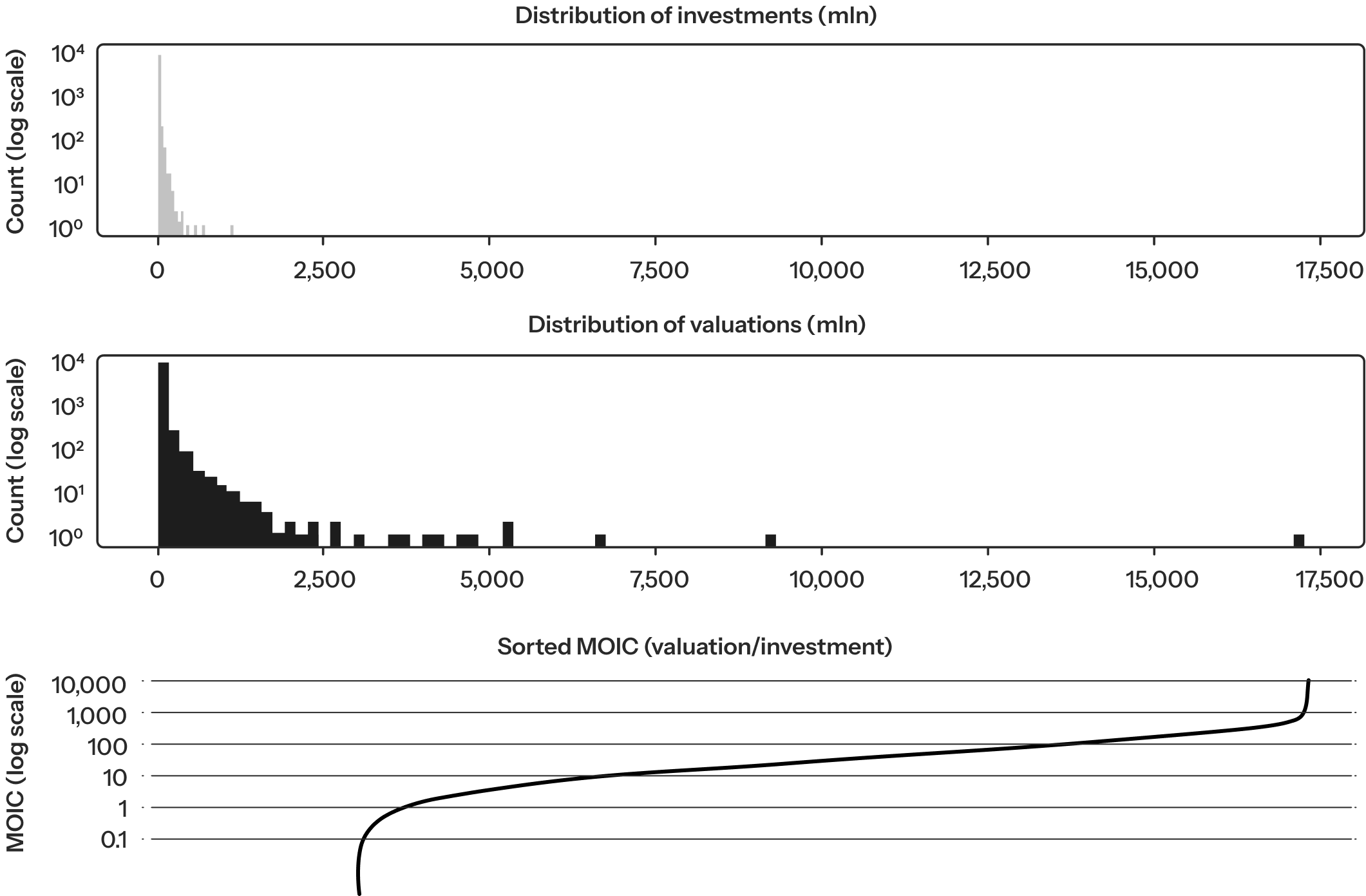
“The biggest secret in venture capital is that the best investment in a successful fund equals or outperforms the entire rest of the fund combined”

Peter ThielFounder of PayPal

“Europe’s strength lies in our ability to turn innovation into impact — by connecting visionary capital with transformative ideas, we shape a resilient and sustainable future”

Michiel SchefferPresident, European Innovation Council Board

“What differentiates sustainable investing from philanthropy is a focus on financial materiality, prioritizing those stakeholders that matter most to your future success. This is in stark contrast to the 'tick box' approach to ESG, where companies try to be all things to all men and look good on every metric, which just leads to greenwashing and unproductive investment.”

Katherine DavidsonInvestment Manager, Baillie Gifford

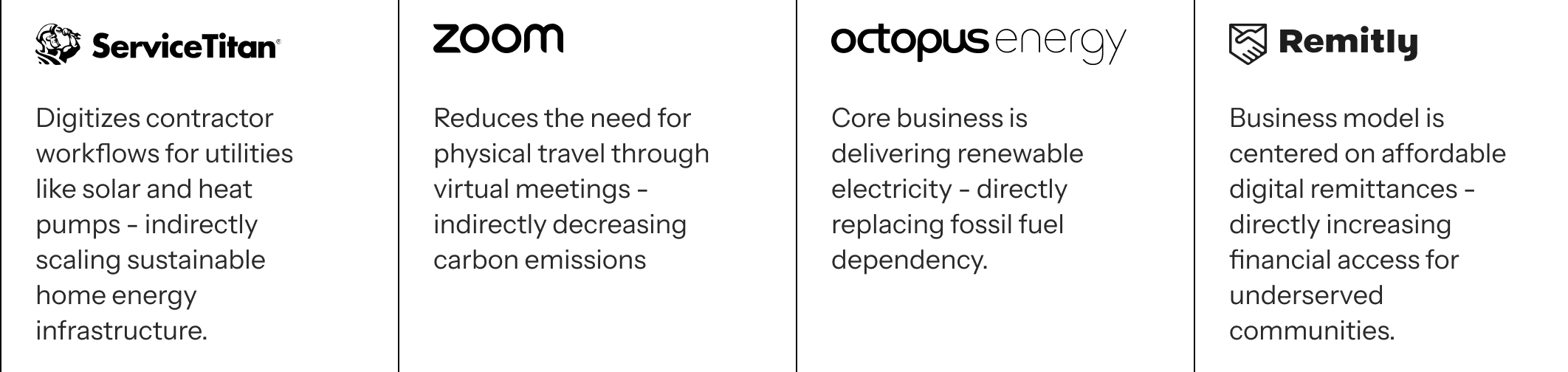
"At Remitly, we’re relentlessly focused on making the cost of sending money internationally fair and transparent, because every dollar saved is a dollar that stays in the hands of the families who need it most. Our capital-efficient model, built on trust and a per-transaction approach, ensures that as we grow, our customers benefit. We’ve shown that real impact isn’t at odds with financial success - it fuels it”

Matt OppenheimerFounder, Remitly

"The best businesses solve systemic problems at scale. By rethinking outdated risk models, we’ve built a fairer, faster, and more scalable insurance model that proves financial inclusion and profitability go hand in hand”profitability go hand in hand”

Oliver Kent-BrahamCEO, Marshmallow Insurance

The most investable companies aren’t just scalable, they’re catalytic. By embedding solutions to systemic problems into commercially viable models, Problem Solvers unlock supercharged incentives: powerful economic drivers activated when externalities affect multiple stakeholders.

When a problem harms society, markets, and institutions at once, solving it creates aligned motivation from governments, consumers, and partners alike. These supercharged incentives drive multiplier effects: second-order impacts that cascade beyond a company’s core product or service. When properly aligned, they lead to systemic adoption, policy support, and long-term market resilience.

Most companies exist on the spectrum between two extremes:

  1. Impact actors: Those that trade off financial returns for social impact, which are often undercapitalized and overly reliant on policy or philanthropy. For example, companies like SunPower and Northvolt aimed high on impact but buckled under capital intensity and miscalculated policy risk. Such high-profile collapses are reminders that solving a big problem isn’t enough if the business model is capital-intensive, exposed to policy volatility, or unable to scale within (venture) investment timelines.
  2. Pure-play disruptors: Those that chase fast growth by exploiting short-term inefficiencies, scaling rapidly but burning trust, resilience, or regulatory goodwill. For example, firms like GoPuff and Shein have scaled fast by chasing convenience and cost, but increasingly at the expense of consumer backlash, regulatory defensibility, resilience, or simply increased competition from ‘better, faster or cheaper’ alternatives – entering a race to the bottom that is hard to escape.

Problem Solvers break this binary logic. They embed solutions to structural problems within commercially scalable business models, unlocking aligned incentives across customers, regulators, and partners. These companies transform societal urgency into commercial pull, attracting partners and coalitions who benefit from the problem being solved, including:

  • Consumers: who seek better, cheaper, more ethical alternatives, especially when traditional options are failing them.
  • Governments and regulators: who support solutions aligned with public goals like decarbonization, inclusion, and digital access, often through subsidies, procurement, or regulation. 
  • Communities and civil society: who see broad societal benefits – job creation, economic empowerment, environmental gains – and drive grassroots adoption or pressure for policy change. 
  • Innovators and visionaries: who rally talent, capital, and public attention around a shared mission. 

These aligned stakeholder interests generate multiplier effects: ripple effects that amplify the company’s value, reach, and defensibility far beyond its core offering, generating economic and societal value simultaneously. These ripple effects include:

  • Policy tailwinds: When a business helps solve a public priority (like decarbonization or inclusion), governments want it to succeed. That translates into subsidies, faster approvals, and protective regulation –  advantages pure-play disruptors rarely enjoy.  
  • Market catalysts: By solving foundational problems, they open up entirely new markets. Affordable diagnostics can catalyze digital health innovation; improved water access can accelerate advances in agriculture and insurance. In this way, Problem Solvers lay the market foundations for others to build upon.
  • Systemic resilience: Their value extends beyond individual users, reinforcing the infrastructure they operate within. Consider a fintech that broadens access to savings contributes to a more inclusive financial system, or a renewable energy provider helps stabilize and modernize the grid. This embedded resilience makes them trusted anchors during periods of volatility. 

Because these companies strengthen the systems they operate within, they are naturally more resilient to shocks. They gain trust from stakeholders, such as governments, institutions, and consumers, who have a vested interest in their success. Their alignment with major public priorities, from the Inflation Reduction Act to the EU Green Deal, attracts additional protection, funding, and adoption when volatility hits. This creates a virtuous cycle: the more they grow, the more valuable they become to the ecosystem around them – and the harder they are to displace.

“I’m convinced the biggest business play of our era is tearing down the old gate-kept rules of commerce. At Shopify we’re obsessed with bulldozing every barrier so any scrappy founder, anywhere on the planet, can spin up a brand and sell to the world. Leveling the playing field for entrepreneurs isn’t just good karma - it’s rocket fuel for the global economy”

Harley FinkelsteinPresident of Shopify

The most successful businesses don’t start with tools; they start with urgent, persistent problems and build from there. For decades, venture capital has followed the gravitational pull of new technology. From the rise of the internet to mobile, cloud, and now artificial intelligence, each wave has brought with it the promise of transformation – and the temptation to start with the tool, not the need. This is the logic of technology solutionism: build with the latest breakthrough, then search for problems to solve. But while this mindset often drives hype and short-term speculation, it often does not deliver lasting relevance.

This “tech-first” approach tends to results in:

  • Incremental improvements: products that are slightly better, faster, or cheaper but fail to deliver transformational impact.
  • Missed system-level opportunities: such as inequality or climate change, sometimes exacerbating negative externalities.
  • Speculative markets: that collapse due to weak demand and lack of problem-driven adoption.

Problem Solvers do something different. Rather than beginning with a technology and searching for a use case, Problem Solvers begin by identifying a real-world challenge – a systemic pain point that that persists over time, creates systemic cost, and erodes trust in key systems. They look at what’s broken, where incentives are misaligned, and where underserved users are being excluded. Only then do they choose the tools – technological, financial, operational – that are best suited to solve the problem at hand. Their focus is not to exploit what’s trending, but to solve what’s enduring.

Problem Solvers don’t ask, ”What can we build with this new tech paradigm?” They ask, ”What problem must we solve – and what tools will get us there?” This mindset defines Benevolent Disruption: a problem-first approach grounded in real-world relevance. The result is fit-for-purpose design, rather than theoretical experimentation It shifts the role of technology from end-goal to enabling – and the role of capital from trend-chasing to systems-building.

“The most enduring innovations come from working closely with the communities that technology is meant to serve. At Google DeepMind, we seek input from ethicists, academics, and local populations early to create technology that prioritizes users' needs whilst addressing global challenges.”

Lila IbrahimCOO, Google DeepMind

At Vinted, we’re making the change to second-hand. Second-hand is better than new, for the climate, and for your wallet. We've already helped tens of millions across Europe discover how easy it is to buy and sell second-hand fashion, and we’re just getting started. We’re now moving into electronics, furniture and more - and are building our own shipping and payments infrastructure to make second-hand as easy, safe and convenient as new”

Thomas PlantegaCEO, Vinted Group

“Technology has always been a driver of progress — from the internet and search engines to today’s AI breakthroughs. Used intentionally, it has the power to solve some of the world’s biggest challenges. Venture capital plays a critical role in backing consequential companies early and helping them scale, ensuring innovation translates into real-world impact.”

Patrick PichetteFormer CFO, Google

“ESG was a marketing fad but making money never goes out of style. By focusing on sustainability, you create a ‘circle of competence’ - a deep understanding of industries and themes where sustainability drives outsized returns”

Meraj SepehrniaFormer Head of Total Return Sustainability at Pictet Asset Management

“The most valuable companies of the future will be those that turn today’s externalities into tomorrow’s core business models. Investing in solutions to environmental and social challenges isn’t just responsible — it’s essential for resilient, long-term returns.”

Madeliene EvansDirector, Generation Investment Management
Adam Smith (1759, 1776)

The Theory of Moral SentimentsandThe Wealth of Nations 

Karl Marx (1867)

Das Kapital 

Joseph Schumpeter (1942)

Capitalism, Socialism and Democracy 

Milton Friedman (1962)

Capitalism and Freedo

Richard B. Du Boff (1967)

The Introduction of Electric Power in American Manufacturing 

Eugene Fama (1965)

Efficient Capital Markets: A Review of Theory and Empirical Work 

Gordon Moore (1965) and Robert Metcalfe (1980)

Moore’s Law and Metcalfe’s Law

Clayton Christensen (1995)

Disruptive Technologies: Catching the Wave (Harvard Business Review)

Peter Thiel (2014)

Zero to One: Notes on Startups, or How to Build the Future

Max Roser ( 2016, updated 2024)

The Short History of Global Living Conditions and Why It Matters That We Know It

Thomas Ramge & Rafael Laguna de la Vera (2020)

Radical Innovation Needs Old-School VC (MIT Sloan Management Review)

William MacAskill (2022)

What We Owe the Future

Samuel Kortum & Josh Lerner (2000)

Assessing the Contribution of Venture Capital to Innovation

Paul Gompers & Josh Lerner (2002)

The Venture Capital Cycle

Paul Gompers et al. (2009)

Specialization and Success: Evidence from Venture Capital (Journal of Economics & Management Strategy)

Josh Lerner & Ramana Nanda (2020)

Venture Capital’s Role in Financing Innovation: What We Know and How Much We Still Need to Learn

Hemant Taneja (2022)

Hemant’s Year-End Letter to LPs   

Maxime Bonelli (2022)

Data-Driven Investors

Sabrina Howell et al. (2023)

How Resilient is Venture-Backed Innovation? Evidence from Four Decades of U.S. Patenting

Arun Gupta, Gerard George & Thomas J. Fewer (2024)

Venture Meets Mission: Aligning People, Purpose, and Profit to Innovate and Transform Society

Gerard George, Thomas J. Fewer, Sergio Lazzarini, Anita M. McGahan & Phanish Puranam (2024)

Partnering for Grand Challenges: A Review of Organizational Design

C.K. Prahalad (2004)

The Fortune at the Bottom of the Pyramid: Eradicating Poverty through Profits

Robert G. Eccles, Ioannis Ioannou & George Serafeim (2014)

The Impact of Corporate Sustainability on Organizational Processes and Performance

Shawn Cole et al. (2022)

What Do Impact Investors Do Differently? (Harvard Business School Working Paper)

Florian Berg, Julian Koelbel & Roberto Rigobon (2022)

Aggregate Confusion: The Divergence of ESG Ratings (Review of Finance)

Alex Edmans (2024)

Growing the Pie: How Great Companies Deliver Both Purpose and Profit (Updated Edition)

Alex Edmans, Tom Gosling & Dirk Jenter (2024)

Sustainable Investing: Evidence from the Field (ECGI Finance Working Paper No. 1028/2024)

Colin Mayer (2024)

Capitalism and Crises: Rethinking Corporate Purpose (Oxford Review of Economic Policy)

Columbia Center on Sustainable Investment (2024)

Climate Impact Screening and Reporting: A Venture Capital Perspective

Tim Berners-Lee (2024)

Marking the Web’s 35th Birthday: An Open Letter      

Morris Abramowitz (1956)

Resource and Output Trends in the United States since 1870.

Robert M. Solow (1957)

Technical Change and the Aggregate Production Function

Eric D. Beinhocker (2006)

The Origin of Wealth: Evolution, Complexity, and the Radical Remaking of Economics

Donald MacKenzie (2006)

An Engine, Not a Camera: How Financial Models Shape Markets

Andrew Lo (2017)

Adaptive Markets: Financial Evolution at the Speed of Thought

Kate Raworth (2017)

Doughnut Economics: Seven Ways to Think Like a 21st-Century Economist

Nicholas Bloom, Charles I. Jones, John Van Reenen & Michael Webb (2020)

Are Ideas Getting Harder to Find? 

Ashish Arora, Sharon Belenzon & Lia Sheer (2021)

Knowledge Spillovers and Corporate Investment in Scientific Research   

Gerard George, Ryan Merrill & Simon Schillebeeckx (2021)

Digital Sustainability and Entrepreneurship: How Digital Innovations Are Helping Tackle Climate Change and Sustainable Development 

Satish Nambisan & Gerard George (2024)

Digital Approaches to Societal Grand Challenges: Toward a Broader Research Agenda on Managing Global-Local Design Tensions